Blog: Fr. Robert

Which Psalter?

Reading the Psalms is one of the devotional practices I recommend over and over again. The question I often get in respond to my recommendation is which translation to use? My standard response is use the one you are familiar with already. By using a translation you are familiar with whether based on the Septuagint or the Hebrew text, it is already in your memory and much easier to make the Psalms your prayer.

I grew up a Lutheran using TLH so the Coverdale Psalter is the translation of the Psalms I am most familiar with. So when I pray privately the Psalms that is what I use. This is the same translation that is used in the 1662 Book of Common Prayer.

The only restriction I put on the above recommendation is do not use an inclusive language translation. The main reason I avoid inclusive language translations is the Christological nature of the Psalms are lost. The Psalms are the prayers of Jesus. When Jesus cries out on the cross,"My God, my God, why have you forsaken me?" He is praying the Psalms. When Psalm one says,"BLESSED is the man that hath not walked in the counsel of the ungodly, nor stood in the way of sinners." this is a reference to Christ not us sinners. Inclusive translations usually translate the singular male noun or pronoun as a inclusive pronoun. For example, the Inclusive translation of the Grail Psalter starts with," Happy are those..." The translation completely destroys the Christological nature of the Psalm.

What if you are new to praying the Psalms, what translation should you use? The short answer is use the one your parish uses. My parish uses the Psalter for Prayer. This translation is an adaptation of Coverdle's translation to match the Septuagint text. So if you were in my parish that is the one I would recommend. Check with your priest which is one the parish uses. There are several good Septuagint based Psalters, Psalter for Prayer, The Psalter according to the Seventy, the Ancient Faith Psalter, and the Psalms in the Orthodox Study Bible. So most likely they are using one of the above.

Some of you may have noticed I am pointing out translations based on the Septuagint but personally I am using one based on the Hebrew text. There are differences between some of the Psalm texts which are important to know for study and liturgical use. Private prayer and devotion are another matter. Using words you are familiar with in prayer are more important than whether they are based on a certain translation assuming the translation is not problematic in someway.

Also please note my use of a Hebrew based translation is for private devotion not liturgical use. I do use a Septuagint based translation for liturgical services.
Bye Bye Joomla

I have completed my move from Joomla. For years I developed websites in Joomla, but when I quit developing websites I found my remaining personal websites did not need a CMS as complex as Joomla. Not that I dislike Joomla, it is a great CMS. But I don't need a One ton truck anymore.

So I started looking for a smaller simpler flat CMS. I came across a small CMS called Yellow from Sweden. I have no idea how big the user base is but it met my requirements: simple to setup, and simple to use.

There are many flat CMSs out there Grav, Pico, and many others. The only way to find out which one is best for you is to try them and see which one works for you

I tried Grav but did not like it. That is not to say Grav is bad in fact it is one of the most highly rated and popular flat CMSs. My philosophy is that in a CMS the content, the plugins, and the templates should be independent. One should not be dependent on the other. That is not the case with Grav. The way the templates work content can often be template dependent. If you never change templates that is never an issue but if you have an existing Grav site and change templates it is quite possible and very probable that your site would not display and error out. You would have to edit every article to make it compatible with the new template before the site would be functional. I believe there is a way to bootstrap templates so your site can function if you change templates but that seems like a lot of extra work.

But that is why there are many CMSs. I like Yellow you may not. I didn't like Grav you may thing it is great. Pick the one that works best for you.

Cupcakes from Scratch

As you may know my wife works for a non-for-profit and last weekshe had an appreciation event for her volunteers. I volunteered to make cupcakes. After some trial and error I came up with a recipe that is a hybrid of two others. The first is a yellow cake recipe from Taste of home . The recipe can be found here https://www.tasteofhome.com/recipes/old-fashioned-yellow-cake/print The second is a cupcake recipe that can be found here. https://noopurskitchen.com/2017/01/11/vanilla-cupcake/

Here is the resulting hybrid recipe. I listed amounts for 8 cupcakes but it can easliy be upscaled for more. If you muliply the amounts by 3 you will get the same amount as a box cake mix.

Ingredients

  • 1/6 cup Butter
  • 1/6 Cup Oil
  • 1/2 cup sugar
  • 1 egg
  • 1/2 teaspoon vanilla extract
  • 3/4 cup all-purpose flour
  • 1 teaspoon baking powder
  • 1/4 teaspoon salt
  • 1/2 cup 2% milk
  • Possible Variations to add
  • 2 TablespoonCocoa Powder
  • 1/2 Teaspoon Mint Extract
  • 1. Preheat oven to 350 deg F. Line a 12-muffin tray with 8 cupcake liners.
  • 2. In a bowl, sift the flour, sugar, baking powder and salt.
  • 3. Add the butter and mix till you get a crumbly texture.
  • 4. In a separate bowl, add the milk, oil, vanilla and egg and mix slightly.
  • 5. Add the liquid mixture to the dry slowly and mix until well combined.
  • 6. Scrape the bowl once and mix again for about 30 seconds.
  • 7. Using an ice-cream scoop or 2 spoons, scoop the batter equally into the tray. They should fill a little more than half.
  • 8. Bake the cupcakes for about 15-18 minutes till the skewer inserted comes out clean.
  • 9. Remove from the pan and let them cool completely on a wire rack.
  • 10. Serve them with a frosting of your choice – I frosted them with buttercream.
  • 11. These should be stored at room temperature in an air-tight container. They taste best the day they are made.

Training Wheels Paella

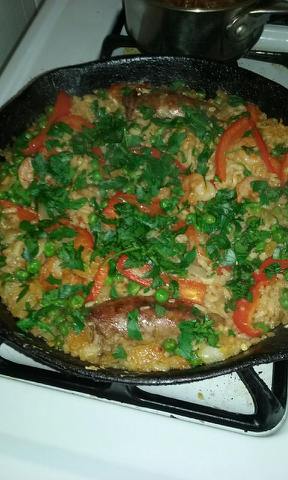
Last night I cooked my first paella. To the purist it was not really paella but it was a good first attempt.

I used Food Wishes' Sausage and Shrimp Paella recipe. It turned out really well. I did one minor change and one major change.

The minor change was I used fresh Andouille sausage and left it in link form rather than slicing it.

The major change was I did not have any saffron. I used a substitution suggested by The Spruce Website. For every 1/4 teaspoon of saffron I used 1/8 teaspoon of tumeric plus 1/2 teaspoon of paprika. While I can not speak to how authentic the taste was, the taste was very good.

While not an authentic paella my wife loved it and is that not the true measure of a recipe?

paella

Upgrading Treat Dispenser

During Christmas break I found a replacement AC adapter for Roman's treat dispenser. The treat dispenser is an Esquilo project. Esquilo is WiFi enabled physical programmable circuit board.

The treat dispenser is a repurposing of Patrick Jackson's Internet-enabled Candy Dispenser. The only change I did was hot gluing the auger to the servo rather than screwing them together. The idea being the hot glue functions like a sheer pin. If the auger jams the hot glue will break rather than burning out the servo.

The library has a 3-d printer which was great way to get the mounts and auger made.

The project is an easy beginner project in terms of both programming and hardware assembly. So give it a try today.